TIME TO REFLECT: Vermilion had not really received a significant snowfall for quite some time - until yesterday. I don't know how much snow fell. But it was enough to slow things down for a day.
Good.
It's nice to have an unexpected break in the daily routine.
I was able to spend a great deal of time reading (more than usual). I also spent some time looking at some webpages of persons I don't know; and reading of the various problems they are having with technical details pertaining to those pages. Some I understood. Some not.
I've been working with using a web editor called "Sandvox". That's the editor I used for the The First 100 Years... history page that I recently completed. The editor is a "WYSIWYG" (What-You-See-Is-What-You-Get editor. [Despite the name I can also use "html" with the editor.]
But in any case, what I found were some real interesting people. I am amazed at their talent(s). Their interests are, of course, varied (i.e. business, music, art, cooking, crafts, poetry, psychology, etc.). But their accomplishments - their abilities - are very impressive.
The experience makes me feel like I just fell off that proverbial "turnip truck" on my way to market in the "big city".
But I think that's good. Sometimes a person needs to be reminded of their right size and be satisfied with it.
Humbly,


"A man of superior business tact and sense, Mr. Hahn wisely invested a part of his accumulations in land."
CHARLES HAHN: The lead to the piece which follows was given me by Vermilionite Margaret Wakefield Worcester. Margaret's husband, Charles "Chuck", was researching the history of his family when he happened across a Hahn family member who told him about Charles (and gave him a pic of the old family home that once stood where the former Lorain, Ohio Ford Assembly Plant stands). She also emailed me a lead where I found the following detail information on Mr. Hahn. It's from the "History of the Western Reserve" by Harriet Taylor Upton - Vol. III - 1910. Methinks you'll find it interesting.
Charles Hahn.—Noteworthy among the substantial and progressive agriculturists and solid business men of Black River township, Lorain county, is Charles Hahn, a well known farmer and the president of the National Bank of Commerce of Lorain. He was born, June 11, 1848, on the farm where he now lives, which is finely located on the lake shore, five miles west of Lorain. He is of German ancestry and a son of George Hahn, who came with his father, Peter Hahn, to Ohio in 1837. On coming from Germany to Ohio with his family Peter Hahn settled on a farm in Black River township, about two and one-half miles west of Lorain, and was there employed in tilling the soil until after the death of his wife. Subsequently, with two of his sons, he removed to Iowa, going there about 1856, and was there a resident until his death.
Obtaining a thorough knowledge of agriculture while living with his parents, George Hahn became a farmer from choice, and after his marriage began life for himself on thefarm now owned and occupied by his son Charles, the subject of this sketch. True to the principles in which he was brought up, he practiced thrift and economy and accumulated a good property, and is residing on his farm at the advanced age of eighty-nine years. He married Elizabeth Bretz, who was born in Germany and came to Lorain county with her parents in 1833. She died March 3, 1889, aged eighty years.
The only surviving child of his parents, Charles Hahn was reared on the home farm and was educated in the district schools and at the Oberlin Business College. Succeeding to the management of the farm on which he has spent his entire life, he has followed his chosen vocation with exceptionally good results. In addition to adding substantially to the improvements of the place, he has from time to time bought more land, increasing its area to 400 acres, which it at one time contained. The Nickel Plate and Lake Shore Railway companies together took ten acres belonging to his farm, leaving Mr. Hahn now with 390 acres of as rich and fertile land as can be found in this part of the state. A man of superior business tact and sense, Mr. Hahn wisely invested a part of his accumulations in land, and formerly owned two other valuable farms, one of 126 acres, near Oberlin, and another, containing 236 acres, in Erie county, Ohio. These farms he has given to his sons. He was one of the organizers of the National Bank of Commerce of Lorain, of which he has been president since its incorporation.
Mr. Hahn married Catherine Baumhart, who was born in Black River township, Lorain county, March 17, 1852, a daughter of Adam Baumhart, who came to Ohio from Germany with his father, Elias Baumhart, when he was about sixteen years of age, in 1837. Adam Baumhart was born in 1821, in Germany, and died January 1, 1894, in Ohio. He married Christina Herwig, who was born in January, 1826, in the fatherland, and came to this country as a child with her parents. She died in 1904. Eleven children were born to Mr. and Mrs. Baumhart, as follows: Amelia, wife of Benjamin Claus, of Brownhelm township, Lorain county; Elias, living in Amherst township, married Margaret Jacobs; Jacob, deceased; Henry, deceased; Mrs. Hahn; Armina, widow of the late Samuel Garrett; James, of Brownhelm township, married Margaret Trinter; Edward, deceased;


"Just over the horizon Spring..."
PAINTING THE TOWN: As previously mentioned this is a preview piece for a new webpage that I am currently developing. Using a new software program in conjunction with Adobe's Photoshop CS4 I am able to take some already wonderful pix of Vermilion, O. and make them (at least in my view) more "wonderfuller"
For some years now a friend, K. (Dickason) Kvach, has been asking me to take a picture of the lake when it is frozen over and the ice begins to pile up in mounds across that frozen desert. Truth be told the lake hadn't frozen over for a long time - so I never got a pic.
But this year the lake has frozen over. The big mounds of ice have not yet become a large as she might recall. But I went down to the foot of Main Street anyway and took a series of photographs of the lake - from the breakwall (northeast) to the west horizon. And afterward I stitched the pix together to make the panoramic view seen in the photo-painting above.
It's not exactly what was requested - but it's fairly representative of Lake Erie in the winter. It captures the proper feeling.
Just over the horizon Spring......
Beautiful.
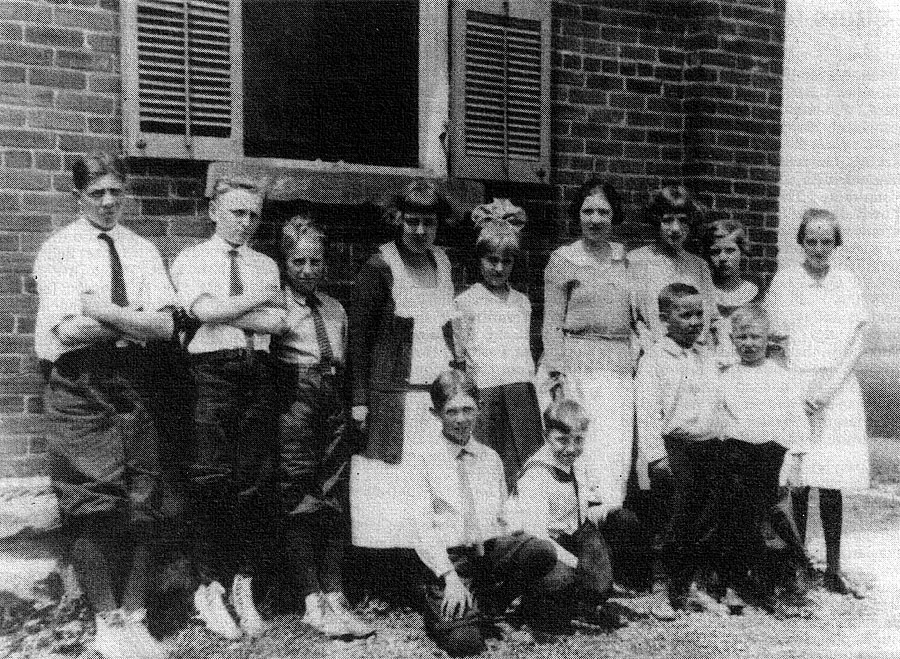
"Amos grew up in Axtel. His parents were farmers. They had 156 acres..."
AMOS: A FRIEND AND AMAZING PERSON: 1923. Here we are at the large metropolis of Axtel, Ohio. We’re at their school. And this is the class.
Back row (left to right): Arnold Palmer, Leonard Crawford, Amos Feiszli, Violet Ottzel (teacher - teacher who became Amos’s sister-in-law) Grace Feiszle, Emma Bartholomew, Nedda Kropf, Irma Bauman, and Mildred Geghenhimer.
Front row (left to right): Clifford Washburn, Wilbur Standon, Charlie Palmer, and Elmer Bristol.
Amos wisely is one of my favorite people. I had breakfast with him at the nest restaurant last Sunday. I’d been hunting him for a week. I went to his church a week ago thinking I’d get to talk to him. Because of my bum leg I took the elevator to the sanctuary. I was 10 minutes late to the service. I walked into the room and asked the usher if Amos was there. I was told he wasn’t. But I really, truly, wanted to talk to Amos.
So last Sunday I took a chance. And there he was at our table the Churchmen United breakfast. What a guy.
Amos is 91. He amazes me. He always did. He used to drive our country root for Mobile Meals. And when the weather started getting tough he decided to retire. He was in his late 80s.
That was good thinking. Because I did that route after Amos left and landed on my butt delivering one day.
Amos grew up in Axtel. His parents were farmers. They had 156 acres (I believe) just south of that water tower out there (near Trinter Road). The picture, here. Is taken just outside that which became the Vermillion Grange Hall. Still standing, it’s now privately owned.
When I spoke to Amos he told exactly where his family lived when they lived in separate places in town. He remembered the addresses precisely.
Amos worked at the Wakefield lighting company and their predecessors for 47 years. Now “he is” a dedicated man. A great person.
His sister, Grace is also in the photograph. I’d not miss her for a moment. She married George Roberts. George had several gas stations in town. Grace is now, I believe, in a nursing home, and the children, Leslie Ennis, Lynn Hurd, Tom, and the grandchildren are still about town.
Amos has two boys. Glenn and Ed. Glenn recently retired from the city, and I don’t know very much about Edt I received this photograph through Amos’s daughter-in-law, Barbara West Feiszli, and I thank her.
[NOTE UPDATE: Since the writing of this piece in 2002 Grace Roberts, her daughter Lynn Hurd, and Amos have all gone to their final rewards. In some respects this piece is more autobiographical than historical - and that I do regret.]
Ref: Published in the Vermilion Photojournal on May 30, 2002; Oral transcription made Oakwood Dr. in Vermlion on February 22, 2010.


nothing ever remains the same...
SOMETHING OLD - SOMETHING NEW: The idea for this piece began as an idea for a coffee-table book of historical photographs of Vermilion, Ohio and, hopefully, it will (someday) be realized.
Originally the concept - as previously stated - was just a picture book. But after mentioning such a project in an issue of my weekly web page - Vermilion Views - a reader by the name of Scott Dommin suggested that it might be interesting if it featured photographs of how people, places, and / or things in the City of Vermilion, Ohio appear today along with photos showing how they appeared in the past. Ergo; the title "Now & Then".
"What a great idea." I told both myself and Scott.
[NOTE: Currently I'm (still) awaiting a proposal from another publisher - and it seems like it will be very workable. I should know something next week - "fer-shure".]
The bottom photograph is a rather unique photograph of the Fischer Building on the corner of Main Street and Liberty Avenue as it was being constructed in 1915. The building occupies the corner where once the Maudelton / Lake House Hotel stood until it was moved downhill to the corner of Liberty and Exchange Streets.
At one time the second floor housed a roll-skating rink. The floor is hardwood. And when I was a tad it served as the village kindergarten. In the early 50's I watched a fishery along the river burn from the vantage point of a window in the upstairs of the building.
Over the years many businesses - including the Vermilion Post Office - were located in the building. Seldom are any of the shops empty.

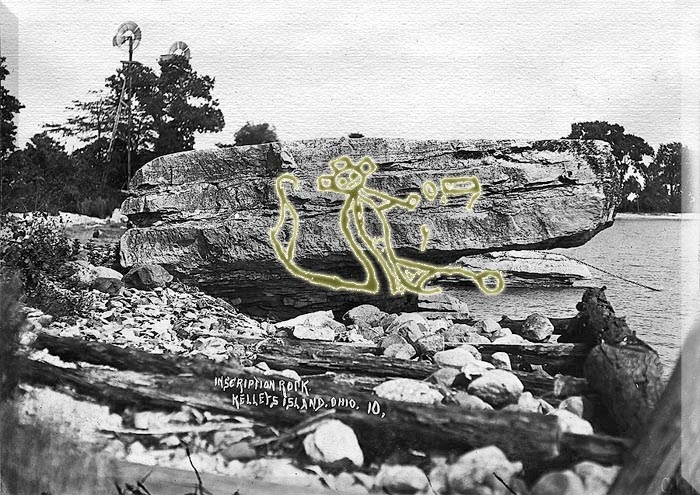
The inscription supposedly refers to the war
of a "lost nation" of Indians.
PREHISTORIC FIRE-LANDS: I found the following information re: the pre-history of our community to be well written and extremely interesting. Although we can't know for sure what things were like in our area before records were kept - some things were left behind...
INDIANS OF THE FIRE-LANDS
When and whence came the red men to the Fire lands, no research will now inform us. It seems most probable that they were of Asiatic origin and drifted across the country from the northwest, but the matter is one of conjecture, and it is not the province of this work to discuss the arguments in favor of any particular hypothesis.
Whenever they came and whatever their origin, they found here, on the southern shore of Lake Erie, green and fertile lands, drained by the waters of the Sandusky, the Huron and the Vermillion.
These were prairie and wood land, well watered and abounding in game. It would have been strange if no wandering tribes of red men, whose highest idea of happiness was embodied in a paradise of well-stocked hunting grounds, should not have lingered along the river banks, where, even in the days of the pioneers the feathered arrow of the Indian seldom searched vainly for a victim.
It is interesting to note that here, in one group of counties, by that process of language-petrifaction, which has left upon our lakes and rivers, states and territories, the names which were familiar and expressive words to the tribes of people whose graves are all over the Fire-lands, we have six Indian titles: Erie, Sandusky and Ottawa, Huron, Seneca and Wyandot.
All these but one were tribal designations; but not all the tribes whose names have been so perpetuated had any habitation on the Fire-lands at the coming of the pioneers. Ottawas, Hurons or Wyandots, and Senecas, there were in the first years of this century; but of before that, naught but a memory remained of the Eries, that proud, fierce tribe, whose war with the Five Nations of New York forms one of the most interesting traditions of prehistoric America.
The Eries, it is said, dreaded the combination of five such tribes as, united, made up the Iroquois Five Nations. They endeavored to crush the confederacy in Its inception, but were themselves defeated with terrible slaughter, between Canandaigua lake and the ----- river. They retired to the far west, but tradition says that many years later a war party of their descendants returned from beyond the Mississippi and attacked the Senecas, who had settled upon the fatherland of the Eries; but the result was the second crushing defeat, and the annihilation of the Erie race, unless a remnant was left to mingle with other tribes in the west.
As long ago as the middle of the seventeenth century the Eries probably occupied northern Ohio, along the shores of Lake Erie, and the famous inscription rock on Kelley's Island, have been supposed by Shingwauk, the Little Pine, an Indian archaeologist, to refer to the wars of this lost nation.
After the destruction of the Eries the greater part of northern Ohio seems to have been never so much the peculiar territory of any one nation as the common hunting ground of many.
As white settlements increased along the Atlantic coast, and the natives were crowded toward the setting sun, tribes and remnants of tribes whose homes had been in the east, wandered into Ohio and lingered there, until the advancing army of civilization pressed them still further toward their ultimate destiny.
It is for this reason that in the chronicles of the pioneers we find mention of so many diverse tribes. They were sojourners, most of them, rather than
permanent dwellers on the Fire-lands. The land may have seemed almost as strange to them as to the white settlers.
On the pages of the Pioneer, the magazine of the Fire-lands Historical Society, the earliest of these white settlers have recorded these names of tribes represented here during the first years of the nineteenth century. Of the. Algonquin family, the Miamis or Shawnees, the Tawas or Ottawas, the Chippewas or Ojibways, the Delawares, Shawnees and Potawatomies; and of the Huron-Iroquois family, the Wyandots, or Hurons proper, and the Senecas. Of these tribes, that of the Wyandots is perhaps oftenest mentioned by the pioneers. The people of this tribe lived for the most part along the Sandusky river for many years after the town and villages of the pale faces had sprung up all over the Fire-lands. The Wyandots and, If Hurons were the same people, the latter name being the one bestowed upon them by the French.
In the years when the Iroquois were waging their relentless wars against the Eries, the Wyandots lived on the Canada side of the lakes, although their hunting excursions seem, sometimes, to have reached the regions about the territory of the Miami and that of the Sandusky.
They also became involved in war with the powerful Iroquois, and, as in the case of the Eries. the Wyandots were, as a nation, almost exterminated by the seemingly invincible confederacy of New York. But in later days, after the Eries had ceased to be known in Ohio, and the strife with the Five Nations had ended, remnants of the Wyandots hunted and planted corn along the valley of the Sandusky.
Author: Williams, W. W. (William W.)
Subject: Huron County (Ohio) - History; Huron County (Ohio) - Biography; Erie County (Ohio) - History; Erie County (Ohio) - Biography
Publisher: Cleveland, Ohio: Press of Leader Printing Company
NOT IN COPYRIGHT
Continued Next Week...
God Bless their souls - each and every one.

"...the men on the truck would play. And the townsfolk would, literally, be 'dancing in the street'.."
VERMILION'S RUBE BAND: Did I ever mention that I really feel lucky to have been born and raised in Vermillion. I was born in 1944, Somali “growing up” years were mostly the 1950s. This remain churches: St. Mary’s, he and the Evangelical and reformed, in the congregational. Downtown was really downtown. The village stretch from about Maurer’s Lane in the south, to Lake Erie to the north; and from about Bluebird Beach in the west to the Vermilion-on-the Lake railroad bridge to the east. South Shore shopping center was a muddy parking lot for Crystal Beach Park. Just west of this parking lot was a little drive-in restaurant that was only open in the summer, and the area between it and Vermillion (East River) Road was littered with summer cottages. Romps water pork was a swamp, and the Lagoons - across Liberty Street - was just a growing housing development.
As one might imagine, growing up in a town with a population of 2000 people had its “ups and downs”. One of the “downs” was that everybody knew everybody. Thus, when the person committed some infraction of decency it didn’t take too long for everyone (including one’s parents) to word of it. But, thank heaven, there were many, many “ups”. One of of them was Vermilion’s American Legion Rube Band.
Long before the Festiva ofl the Fsh was invented, Vermilion held little celebrations called “street dances” on several weekends during the summer. Division Street (now Main Street) between the railroad tracks and Liberty Avenue was closed off on Friday and Saturday nights the festivities began. I distinctly remember the Vermilion volunteer firemen being involved in this function. They ran several of the games. Most were games of chance. Even the kids had their games of chance. The “Penny pitch” is one I remember best. You take a penny and try to toss it in one of the few hundred little squares on a large board with numbers in each square. If the penny landed up in a square without touching power line, you won whatever that number might be. A dime would be a big payback.
And here it did Vermilion’s Rube Band play. They cleared space from where Winterstein realty is today (then it was Miller’s hardware and liquor store) [Note: that building is no longer Winterstein] to, perhaps just past the north of Brummer’s Candy Store (then Englebry’s Clothing Store), and threw sawdust on the street. The old band truck would come across the tracks and stop just after the entrance to the Grand/Division Street parking lot (now?); and the men on the truck would play. And the townsfolk would, literally, be “dancing in the street”.
The photograph is a jewel. The Rube Band was a Vermilion American Legion project. This picture was taken in Norwalk Ohio in 1941. By the looks of the truck was an old (1930s) truck chassis with a homemade bandstand built on it.
I don’t know everyone one in the picture. Nug Cook provided most of the names for me, and I don’t know how many are correct. Chuck Trinter or Fred Wetzler may know all of these men. On the bottom left (standing) is Henry “Hank” Ries”. Just above him in the dark shirt was Carl Osberg. Next it him (with the drum on his lap) is his brother, Leonard. The next him in the glasses is “Tiny” Plato. Below them in the middle (in glasses) is “Laddie” Cipra. Chuck Trinter is right above Carl. Right behind Chuck maybe Fred Wetzler. Toward the top in the stripped shirt is Eddie Schwenson next in him as Don Trinter. Just below Don Trinter is Don Krapp. At the very top (left to right) are Bob Trinter (next to the tuba player), Dave Reutener, and then Ross “Tiny” Hayes with the tuba. America was headed for a full-scale war then, and some of the boys in the band would end up there. Others (as it looks) had already spent their time in WWI.
The Rube Band played well into the 50s.. Then, like everything else; things changed. The street dances and the band disbanded. I remember the truck being parked at the Olympic club for time. I know they have pictures of it there. I would assume the band played at the club on more than one weekend. For when it comes to having a good party, the Olympic club was for for a century, and remains to this day, the place to be.
And now some F.Y.I. Ozzy Kelm purchased his truck and still owns it. He keeps it on his property on Cherry Road. What a pleasure would be to see this truck refurbished by one of our local historical groups to be used by Vermilion’s local band in parades, etc. That’s a longshot. But it would be nice.
[UPDATE: Since this piece was written Ozzy Kelm has passed away and the truck was then auctioned off and has disappeared. The only remembrance of it that now remains is the bell (seen on the front of the vehicle). A local resident - Jim Smith’s son - purchased it as a keepsake. Good for him.]
Published in the Vermilion Photojouranal on 1/03/03; Oral transcription with updates made on 2/23/2010 at Oakwood Drive in Vermilion.


OUR WACKY NORTHERN NEIGHBORS
A Canadian customer was calling to find out if there was a
faster way to trigger menu commands than mousing up to the
menus.
Agent: Certainly, sir. There are keyboard shortcuts for many
of those commands. For example, suppose you want to trigger
the Select All command...
Caller: Yes, I use that one all the time! How do I do it?
Agent: Well, you just press Control-A.
Caller (after a pause): Well, that's not working for me.
Agent: Do you have a text document open in front of you?
Caller: Yes, I sure do.
Agent: OK, now press Control-A.
Caller: I am, but nothing happens.
Agent: The text isn't highlighted?
Caller: No, there's no change at all.
Agent: That's odd. If you press Control-A the whole document
should be highlighted. Try it again. Press Control-A. Tell
me exactly what's happening.
Caller (nearing his Canadian breaking point): Listen. I'm
pressing Control, eh? And nothing's happening, eh?


Podcasts - "forever under construction..."
PODCAST #169: This week the Vermilion Views Podcast #169 is an interesting piece on Ohio's great Serpend Mound. It's among the great wonders of our world.
Persons interested in the history of the Lake Shore Electric Railway (which was the subject of a recent past podcast series) - "the greatest electaric railway system on the planet" may want to go to Amazon.com and purchase a book called "Images of Rail - Lake Shore Electric Railway". It was put together by Thomas J. Patton with the help of my friends Dennis Lamont and Albert Doane. It'd make a nice gift.
Also, please note that all the video (MP4) podcasts (when used) are done in the "Quicktime MP4" format. If you don't have "Quicktime" it's easy to find and free to download.
NOTE NOTE:Past podcasts are not available in the on-line archive. They just take up too much disk space. But if one really, really, really wants to acquire a copy of a past cast it can be had by contacting me and I will place it on a disc and send it to ye for a minimal fee.

LOCAL ANNOUNCEMENTS: After giving it much thought this link has been "put-down". During the last year most of the folks who used to use this page as a bulletin board have acquired their own and, consequently, no longer need this forum from "Views". I have, however, kept links (in the links section) to Larry Hohler's "Hope Homes" in Kenya - and to Bette Lou Higgins' Eden Valley Enterprises sites. They are historically and socially relevant projects. I suggest that you visit these sites on a regular basis to see "what's shakin'".
Pay particular note to the "Hope Homes" page during the next few months. They've recently received a significant grant from the Dolan Foundation and are constructing a Manual Training Center for their children and for other young people in that community. This is an exciting project.
Although this years Vermilion High School Class of 1959 reunion is over classmates may want to stay connected with each other through organizer Roger Boughton. Ye can connect by mailing him @ 2205 SW 10th Ave. Austin, MN. 55912 or you can just emailRoger.
Where's Alice? I found this link interesting. You just never know what Vermilion expatriots are up to - or where their up to doing it. Alice Wakefield is one of those people. So check out his link. Methinks you'll be surprised: Talking Turkey.






The Beat Goes On: The page is generated by the dreaded Macintosh Computer and is written and designed by (me) Rich Tarrant. It will change weekly ~ usually on Saturday. Bookmark the URL (Universal Resource Locater) and come back at your own leisure. Send the page to your friends (and enemies if you wish). If you have something to share with those who visit this page, pass it on. And if you see something that
is in need of correction do the same. My sister, Nancy, is a great help in that respect. It only takes me a week to get things right. And follow the links. You might find something you like. If you experience a problem with them let me know. Also, if you want to see past editions of this eZine check the new archives links below.
If you're looking for my old links section (pictured) I've replaced it with a pull-down menu (visible in the small box next to the word "Go"). If you're looking for links to more Vermilion history check that menu.

How the old links menu looked

For Persons who would like to donate to the cause (to keep these "Views" on-line you can send whatever you would like to me at the following address. And THANKS to everybody who has already donated to the cause. I doth certainly appreciate it):
Rich Tarrant
1041 Oakwood Drive
Vermilion, Ohio
44089
Telephone: 440-967-0988 - Cell: 440-522-4459
or you can use PayPal:
"The name's Kaknockers. Vod Kaknockers."
-Jake Harper(Two and a Half Men)
Vol.7, Issue 50, February 27, 2010
Archive Issue #363
Vermilion Views Search Engine


© 2009 Rich Tarrant