SOME VERMILION HORSES: I intended to use this photograph with the following notice that was published in The Vermilion News sometime in 1899:
"I have moved my tayloring shop to my rooms on Grand street one door south of the post office, where I will be pleased to have all of m old customers call on me, and many new ones. My show room is light and neat, and you will be able to see the different shades, styles, and patterns to advantage. John Ritter."
I find the note to be very informative. [John Ritter was, of course, the father of George Ritter who gave Vermilion its wonderful library building.] It allows us an opportunity to know where things were located - one upon a merry old time. I made the additional notes on the pic so that persons unfamiliar with the location of the photo could better orient themselves - because none of the buildings pictured still exist.
It may also interest some to know that the building that was the original home of the The Vermilion News was (at least to the best of my knowledge) also the schoolhouse that had (at one time) been moved from Hanover Square.
However; none of those things is the real reason I used this photo in this weeks "Views". It's here because Vermilionite (historian and co-author of "Custer's Horses; Wolfe Publishing, 2000) Jim Fischer, asked me if I had any pix of horses being used in old Vermilion.
This (here) is one of my very favorites. Before electricity came to town people needed ice. And apparently, if you called Mr. J.N. Englebry at "203" he'd made a delivery.
This is a "staged" portrait. One of P. Roscoe's best. I note the lady in front of the Post Office was over-seeing the operation. And I'll bet the youngster holding the reins to Mr. Englebry's horses didn't care so much about the photo as he did being in charge of the team. That was something to remember!
Coolbeansly,




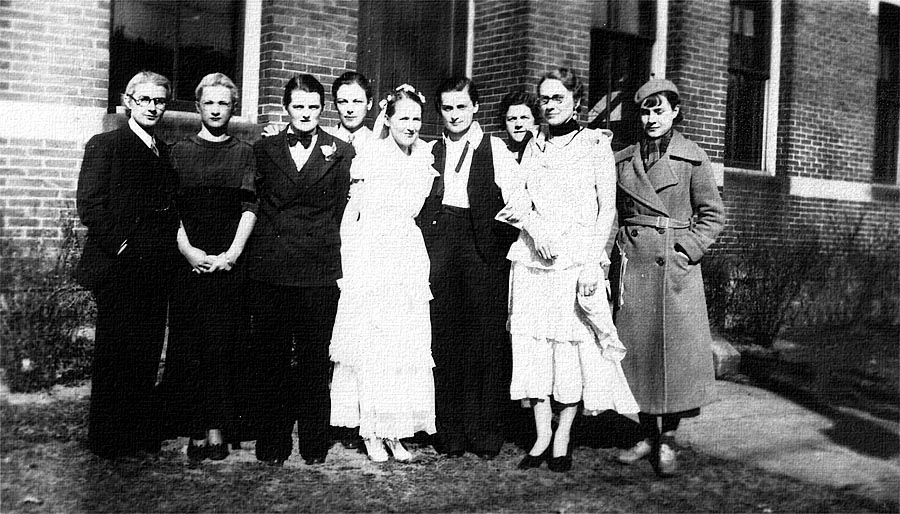
What Was The Play?
IN 1932: This is one of the several pix that Leslie Roberts Ennis allowed me to scan from the Roberts Family photo collection. These shadows were captured just outside Vermilion's Township Hall / Opera House c.1932. The group were appartently cast members in a play being held in the Opera House. The players are:
L-R: Ruby Bogart, Lois Walker, Estelle Smith, Evalyn Burrows, Alice Roscoe, Mary Chadwick, Zella English, Grace Feiszli, and Jane Hart.
It must have been a rather interesting production because it appears that there were not men in it - and several of the ladies are dressed as men. Sometime - when I find the time - I may look to see if I can discover the name of the play.
Grace Feiszli, of course, became Grace Roberts (Leslie's mother). And Alice Roscoe became Alice Lindsay. Miss Mary Chadwick (who - by the way - recently passed away) never married. Zella English was married to the Reverend Earl English (the pastor of the First Congregational Church). The rest of the gals probably married - but I'm not familiar with their married names (at this writing).
This is a very interesting photograph. And someday - when I'm thinking about it - I'll see if I can discover the name of their production. It must have been (as some say today) a real "Hoot!".


A Vermilion Landmark
PAINTING THE TOWN: As previously mentioned this is a preview piece for a new webpage that I am currently developing. Using a new software program in conjunction with Adobe's Photoshop CS4 I am able to take some already wonderful pix of Vermilion, O. and make them (at least in my view) more "wonderfuller"
VERMILION’S “LANDMARK” WATER-TOWER
This is undoubtedly the best pic I've ever captured and manipulated of Vermilion's "Landmark" Water-Tower. It is not, however, quite as healthy as it looks in this water-color photo-painting. And I certainly hope that someone - or some agency - is paying attention to its condition.
In essence it was constructed during the years Vermilion's "singing Mayor" Leonard Osberg was in office (1940-1946). It replaced a smaller tower that was located in Hanover Square (southwest corner of Grand and Huron streets). And it was replaced by a newer tower located on Highbridge Road just south and east of the town proper.
This old tower would have been razed, but was saved from that fate by persons who viewed it as a legitimate landmark for boaters.
I've often toyed with the thought that someone should run some water into the lower part of the tower and let it flow - as though it was leaking - into a basin - making it into a novelty fountain. The tower currently marks the site of Vermilion's Rotary Park where a marker from the Ohio Historical Society and the Vermilion Area Archival Society commemorates the spot where the old Lake Shore Electric Railway crossed the Vermilion River.
From Rich Tarrant's "Painted Vermilion" -
May 13, 2010 1:08 PM.
Beautiful.

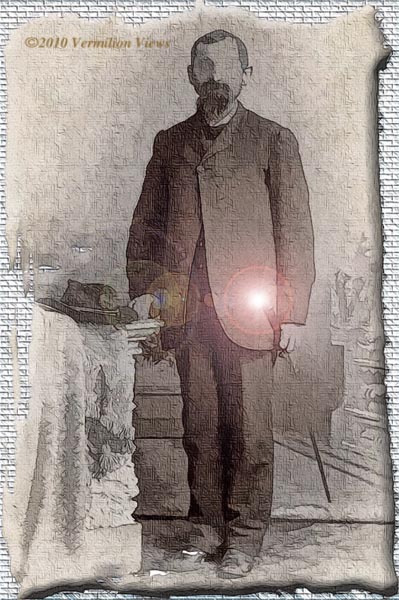
ANOTHER NEW THING: I have, as of late been "batting" my head in an attempt to find a story that someone sent me some time ago about a rather sensational occurance in the area of Vermilion O. I have looked high and low for the paper containing that information to no avail. Tis really a "macabre" story. But, in the meantime, perhaps some other ghastly things will suffice.
UPDATE: Well I did find that story. And I will use it sometime in the future. But I need to do a little more background research before I use it. In the mean - allow me to regale thee with a number of other equally macabre tales...
From The Vermilion News - July 20, 1899
The News, of Bucyrus, has discovered the stingiest man. He lives in Seneca county near Melmore. Last Sunday several Bucyrus wheelmen rested under a tree belonging to him. John Peters, who was in the crowd, was pumping air into his tire when the owner of the premises spied the boy and came toward them, with a shotgun in his hand, and yelling at the top of his voice: “Here! What are you fellers doin’ there?I don’t want you usin’ up all the air around here. Why don’t you bring your wind with your? Git out o’ here now.” And the boys “got.”
*****************************************
A tin pedler [sic] drove out in the country recently and made a deal with a farmer’s wife. The pedler [sic] beat the woman out of 11 cents on her old rags and 17 cents on her old rubber and scrap iron. She worked off on the peddler two dozen rotten eggs at 14 cents per dozen and put two pounds of hen feathers in a sack of goose feathers that she sold at 40 cents per pound. The question for our youthful mathematicians to decide is which one was ahead in the deal.
*****************************************
From The Vermilion News - July 27, 1899
Dear News.
In justice to myself and my horse that was killed on the Fourth I would like to have a little talk and refute some mis-statements which I saw in the columns of the News. C.S. Myres appears to want to exunerate [sic] himself by shifting the responsibility of killing my horse, entirely on the owner whom he said he consulted at four o”clock and gained his consent to go on. He did ask me if I though the horse would stand it until night, but not knowing of the awful hard driving he had through the day, I told him I did not know, but thought he might if used carefully.
He says I may have errored [sic] in my judgement which, he says, sometimes all do for which no one could help but be sorry. Now is S.C. Myres sorry for the error or mistake I made in allowing him to drive my horse to death? If I did error, which I think I did, it was not in the ability of the horse to do his work if properly driven, but in the mental capacity of the man that sat behind him. he also says we knew the horse was not in good condition, why did he put him to so severe a test with the temperature up in the 90 [sic] ? He also claims that he mad only four trips in the forenoon and each time with a light load, putting up at 10:30 and not coming out until afternoon, which, according to the statements of others, is not true, and also putting up at 2:30 and coming out again 4:10 p.m. which I know is not so as I was an eye witness to that myself, this stay at the barn was not to exceed 30 minutes and that was the time I was consulted. He also says that as soon as he saw the horse lag he went to the barn with him, could he not see him lag until he was ready to drop, for he did drop before he could get him into the barn. could he not see after his attention was called to it so many times through the day.
B.F. Bond
[ed.note: Mr. Bond was the town doctor and as one might suspect his horses were extremely valuable to him.]
*****************************************
The bureau of engraving will soon issue a new series of postage stamps bearig the porttraits of heroes of the late war. Dewey, Schley, Sampson, Lee, and other notables will appear on the stamps. Hobson’s face will not adorn the stamps, because the department fears the girls would do most of their licking on the wrong side.
*****************************************
Hmmmmmm....

"...he was the only child of Mary (Gallagher) and John Kilbane."
THE SKINNIEST KID IN THE PARISH: John “Johnny” Patrick Kilbane. The name rolls off the tongue like a good Irish name should. But who was this guy - and what’s he got to do with the pretty city of Vermilion, Ohio?
Persons familiar with the history of prizefighting may know that Johnny Kilbane was a popular 20th century featherweight boxer who held the title from 1912 to 1923. He held that title longer than any other fighter in that division. It was, incidentally, also the second longest world boxing title held by any fighter in history. Only Joe Louis held a title for a longer period of time.
Born on West 28th Street in Cleveland - in a heavily ethnic neighborhood known as “the Angle” - on April 9, 1889 he was the only child of Mary (Gallagher) and John Kilbane. His mother died when he was three, and his father lost his eyesight when he was ten. He attended St. Malachi's School on old Washington Avenue. Having neither brother nor sister, nor any immediate family aside from his father, and very few friends to shepherd him, he would later write that he was “just one of those little kids that run wild...”.
In time Johnny's father remarried and two girls were added to the family. To contribute to their support he left school after the sixth grade and took a job as a laborer on the ore docks along the Cuyahoga River. His years at St. Malachi’s had not been entirely fruitless. While there he had developed a passion for the stage. He had a reasonably good tenor voice, took a few turns at playing the violin, and loved to dance. And whilst his teachers did not discourage his dream of becoming an actor they did encourage him to participate in gymnastics. He would later reflect that he “was probably the skinniest kid in the parish.” Their motive was somewhat suspect and he once quipped that he “presumed that they did not want me to die on their hands.” He was likely correct.
Yet Johnny’s dream of being on center stage persisted - even on the inglorious ore docks where he had, willingly and unwillingly, participated in his share of brawling and street fighting. During his teen years he began frequenting West Side dance halls where his natural dancing abilities easily made him a favorite of the ladies on the floor - but due to his frail appearance took him little further. And it was in pursuit of this passion that brought him one night in the winter of 1906-07 to the old La Salle Club on W. 25th Street that would forever alter the course of his life, and also propel him down on a path that would lead to Vermilion.
A washed-up Irish fighter by the name of Tom Sharkey was there to put on an exhibition match with another fighter named Otto Craig. The match was a no-brainer - but was well attended by a crowd of prominent Clevelanders wanting to see the man who had stood in the ring with other Irish fight heroes like Corbett, Jeffries, and Fitzsimmons. And midst the heavy cigar smoke, the lights, and the general excitement of the event Johnny Kilbane opted to trade the spotlight of the stage for that of the ring.
Confiding his new passion with a boyhood advisor named Perk Gibbons, who ran an elevator in Cleveland City Hall, Gibbons was skeptical - but not wholly critical of his young friend. At the time another friend of Gibbons named Jimmy Dunn was training for an upcoming lightweight match at Crystal Beach in Vermilion. Gibbons gave the boy a note for Dunn, loaned him 30 cents for the fare on the Lake Shore Electric interurban to Crystal, and sent him off in search of his dream.
Upon his arrival at the lakeside park he discovered that Dunn’s sparring partner had injured his hand. This meant that there would be no training exhibition that day unless someone could stand in for the injured fighter. Disappointed Westsiders who knew Johnny elected him for the task, and he accepted. And the youngster who had never before had a pair of gloves on his hands so impressed Dunn with his desire and speed that he invited the youngster to become his pupil. The rest is, of course, boxing history.
On February 22, 1912 Johnny Kilbane fought Featherweight Champion Abe Attel in Vernon, California in front of a crowd of 10,000 people. After a battle that lasted for at least 16 rounds Kilbane won the title by a referee’s decision. During his career he would fight over 140 times, and lose only 4 matches.
But back to Vermilion. Johnny Kilbane established a training camp about 2 miles east of Vermilion Village. It was located on the lake just north of Lake Road on the west side of what is now Helen Drive. The railroad intersects the property. The inset photograph shows Johnny throwing a punch in a sparring match at Kilbane’s Camp. The larger photo is that of Johnny (right) and Jimmy Dunn (left) his mentor, manager, and friend.
After he retired from the ring in 1923 he maintained the camp as a recreation and health camp for young men and boys. About 1929 the New York Life Insurance Company, that held the mortgage on the property, assumed management responsibilities of the facility and renamed it Camp Hakoah. Most the buildings still exist on the property.
Johnny Kilbane is one of those exceptional athletes whose life didn’t end when his athletic career was finished. After his boxing career, Johnny refereed boxing matches, operated a gym, taught physical education at local schools and for a time worked in real estate. In 1941 he entered politics and was elected to the Ohio State Senate. He later served as a member of the Ohio State House of Representatives, resigning that post in 1951 when he became the Cleveland Municipal Court Clerk. Johnny lived in Cleveland his entire life growing up in “the Angle” on W. 28th Street, near old River Ave, and then on W. 74th Street and Laverne Avenue. And on May 31, 1957 he died in Cleveland bested in a final bout with a formidable opponent called cancer.
And that is what John “Johnny” Patrick Kilbane, whose name rolls off the tongue like a good Irish name should, and who once thought of himself as the “skinniest kid in the perish” had to do with the world and Vermilion O. in a yesteryear.
Ref: Johnny Kilbane - Biography by Dan Taylor published in the Cleveland Press in 1952; Johnny Kilbane Memoirs, www.johnnykilbane.com; Special Thanks to Dennis Lamont; Published in the Vermilion Photojournal 6/12/08; Written 6/8/08 @12:50 PM.

 Pictured L-R are: Reverends Kristi Foster, Wendell Brooker, Louis Bertoni, and James Bidle
YET ANOTHER NEW THING: This is but another idea I've stumbled on as I make my way through life each day. As an amateur photographer I don't do many people portraits. I don't know why. I just don't. But I thought it might be nice to do a few of them for "Views" each week - just because. Sometimes they will be my photographs and sometimes they'll be my interpretation of an existing pic. And when possible I will also add a few comments about the subject.
A VERY GOLDEN ANNIVERSARY
On Sunday December 2, 2007 the congregation of Vermilion’s United Church of Christ Congregational church celebrated their 50th year in their building on State Street across from Vermilion’’s Old Schoolhouse. In the big scheme of things 50 years isn’t really a very long time. The half century spent in this building only represents about one quarter of the time the church has existed in the community.
Organized on a cold February day in 1818, when the state of Ohio was only 15 years old and the Village of Vermilion still a dream, it was the beginning of organized worship in this area. Since that day nearly one hundred and ninety years ago, there has been no break in the society's continuing fellowship.
The very first meeting was held in the cabin of Major Eli Barnum on the ridge in Florence Township. (Florence was a part of Vermilion Township until 1817.) The congregation was composed of only six men and six women. Two missionary pastors sent out by the Connecticut Missionary Society were also present; the Reverend Mr. Amassa Loomis and the Reverend Mr. Alvin Coe. Reverend Coe would come to be the first pastor of the fledgling new church.
For about the first decade the congregation met for services in private homes throughout the area. By 1828, church membership reached 42, and a decision was made to erect a permanent house of worship. After carefully considering the location for a building site, a spot was chosen about two and one-half miles from the lake, a few rods east of Risden Road (then called Cuddeback Road).
In 1835 The Ohio House of Representatives granted the church Articles of Incorporation as the First Congregational Church of Vermilion, Huron County, Ohio. Due to shifts in the center of population caused by industrial expansion church officials decided to move the church from the original location to a place on the ridge near Darrow and Vermilion-Savannah (now State) Roads. This move proved to be, however, ill-thought. So - in 1838, church trustees chose Lot 130 on the public square in the newly incorporated Village of Vermilion as the site upon which they would build a new church. The site was just north of the old Town Hall. The building they intended to erect would be brick with a white steeple and trim.
On December 20, 1843 a lovely New England-style building was completed and dedicated . It was the first church in Vermilion Village. The township at that time had a population of 1,400 souls.
As the years passed the congregation grew and the “well used” church was beginning to show it. Some of the bricks were crumbling and were in a "generally dangerous” condition. Thus, 1885 saw church officials appoint a committee to solicit funds for a new and larger church building.
In 1886 the walls were pulled down at a cost of $50 and the bricks cleaned and readied for use for the new foundation. The required new bricks came to $13.50 for 2,250 bricks. The bell had been removed and polished for re-use in the new steeple. In August, the foundation stone was laid with due ceremony, and the congregation adjourned to the E. and R. Church where they continued to meet during the first year of a two-year building program.
On January 15, 1888, the bell from the former church building called a joyful congregation to worship in a new House of the Lord. This building still stands, and is now the home of Millet’s Auction House.
By the 1950’s, increasing membership called for a larger house of worship. After some serious discusssion a committee was set up and a financial campaign began. The campaign culminated in 1956 with a subscription of $164,000. The present four-acre site on State Street, the “old Wilbur property," was purchased and construction was immediately begun.
On December 1st 1957 the congregation gathered in the newly built church on State Street for worship and dedication services. The Reverend James Bidle, Pastor, and Reverend Earl T. English, Pastor Emeritous, presided over those services.
Reverend Bidle served the Vermilion congregation until 1962 when he was called to service elsewhere. Following him was the well known Vermilion Pastor, the Reverend Mr. Louis E. Bertoni, who served until his retirement in 1996. Currently the Reverend Dr. Wendell A. Brooker, and the Reverend Kristi L. Foster conduct worship services, and other activities in the church.
As was indicated at the start of this essay, 50 years - in the big scheme of things - isnt’ really a very long time. But as the Reverend “Jim” Bidle so aptly put it in his Sunday (12-2-07) reflections about his years with the Vermilion church - one must ask oneself at such times, “Where am I now, and where am I now going?” We all know where the yesteryear took us.
It was a
very golden anniversary.
Ref: Betty Trinter, History of Vermilion’s Congregational Church, 1993; Published in the Vermilion Photojournal 12/06/07; Written 12/2/07 @ 5:34 PM.

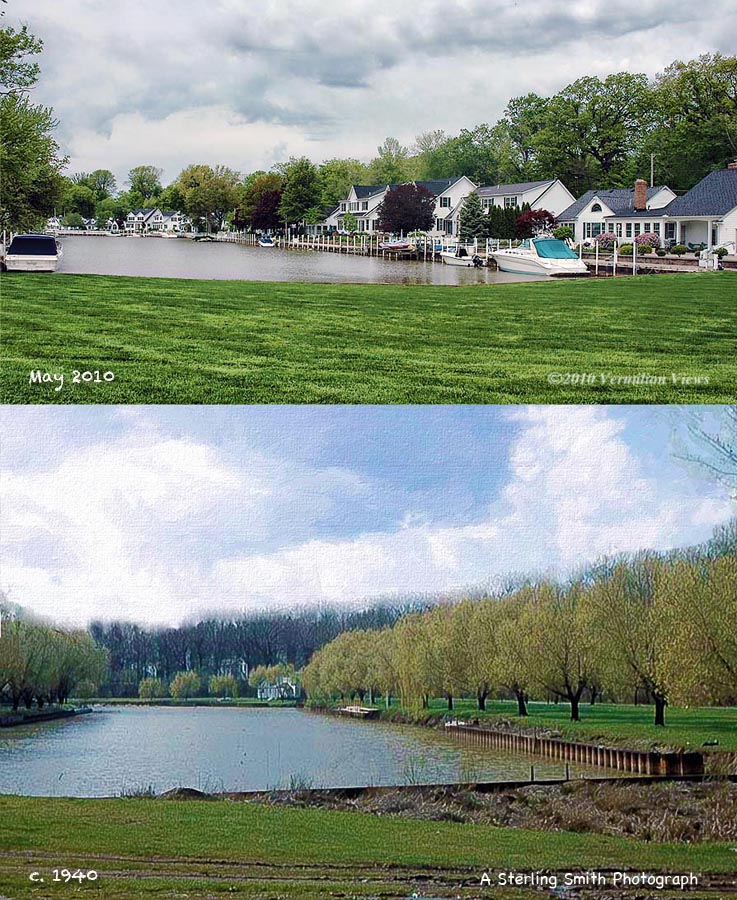
Nothing ever remains quite the same...
SOMETHING OLD - SOMETHING NEW: The idea for this piece began as an idea for a coffee-table book of historical photographs of Vermilion, Ohio and, hopefully, it will (someday) be realized.
Originally the concept - as previously stated - was just a picture book. But after mentioning such a project in an issue of my weekly web page - Vermilion Views - a reader by the name of Scott Dommin suggested that it might be interesting if it featured photographs of how people, places, and / or things in the City of Vermilion, Ohio appear today along with photos showing how they appeared in the past. Ergo; the title "Now & Then".
"What a great idea." I told both myself and Scott.
[NOTE: This is going to take take some time.]
BUILD RESORT AT VERMILION
Lagoons Village Is to Be Constructed.
VERMILION. Oct. 31 — Vermilion is to have a new summer resort, according to plans announced by Mayor Earl S. Welch, of Vermilion.
A large yacht basin is to be built and the lots are to be laid out on lagoons large enough for pleasure craft to navigate. The resort will be on the Smith property which has been taken over by the Wells Construction Co., ot Cleveland. The land Is a 55-acre tract mostly marsh.
Dredging and construction work Is expected to be started on Dec. 15 and the lots are to be available in the spring.
from THE REGISTER, SANDUSKY. OHIO, FRIDAY, NOVEMBER 1, 1929
HASTEN WORK ON LAGOONS
VERMILION, Feb. 27.—Another dredge was added to equipment of the Wells Construction Company here to hasten work In developing the lagoons at the mouth of the Vermilion River, as the opening of the navigation season nears.
Two power shovels and two steam dredges are now at work clearing and filling portions of the marshes to afford a greater landing area for boats during the yachting season here.
The first dwelling in the section for residential purposes Is expected to be built sometime in March,
from THE REGISTER, SANDUSKY, OHIO. FRIDAY, FEBRUARY 28, 1930
VERMILION LAGOONS DEVELOPMENT ONE OF BIG IMPORTANCE
"The New real estate development that has been opened between Linwood Park and the Vermilion river, on the north side of Lake-rd, In the vil!age of Vermilion, by the Wells Really Co. of Cleveland, is attracting much attention.
The development consisting of 60 acres of land, possesses four lagoons openlng into Vermilion river and runs from Lake-rd to Lake Erie, where a swimming beach exists.
L. A. Weils, presidentof the Wells Realty Co., purchased the ground, formerly a low, swampy piece of land, last fall, and spent the winter in digging the lagoons, draining the swampy land and clearing away debris. This spring a new bathhouse was erected there.
All the lots around one of the lagoons have been sold already and owners are making preparations to build immediately. A large number of the homes will be constructed as all-the-year residences while others will be summer cottages."
from THE REGISTER. SANDUSKY. OHIO. SUNDAY. JUNE 15, 1930
May 13, 2010 1:00 PM


"This township was named after the principle river
emptying into the lake through its territory..."
THE FIRE-LANDS: I found the following information re: the early inhabitants of our area to be extremely informative. Methinks you will also.
I am getting better at transcribing these passages so there are fewer mistakes. But I like to read as I go - and sometimes I fill in the blanks. So tread carefully this trail through yesteryear.
This piece - in particular - came to me a while back from a "Viewer" named Lou Shultz who (I am assuming) is member of the faculty of the Columbus Academy.
THE HARROWING EXPERIENCE OF D. GRIFFITHS
D. Griffiths’ rare account of his two years’ residence in the new settlements of Ohio is based upon his residence in Vermillion, OH from September, 1833 until March of 1844. On a chart which appears on page 88 of William S. Kennedy, The Plan of Union: Or a History of the Presbyterian and Congregational Churches of the Western Reserve; with Biographical Sketches of the Early Missionaries.,Hudson, O., Pentagon Steam Press., 1856, we find that: Griffith’s(Kennedy’s spelling) first name was David, that he was born in Longbuckby, England, attended Hackney College, and served as a minister in Vermillion of either the Congregational or Presbyterian Church (the two were united at the time) from September 15, 1833 until March 15, 1834. Griffiths resided with a Judge R (almost certainly Almon Ruggles) for several months and chronicled his experiences on the Firelands in some detail.
The following is a rather humerous account of Griffiths’ trip on the Steam-boat Enterprise in October, 1833:
At the request of a Presbyterian minister, I accompanied him to a meeting of the Synod of the Western Reserve and Michigan, which was held at Detroit. We took the Steam-boat, Enterprise, from the Mouth of Huron River, at eight o’clock on Wednesday night, October 9th, 1833, and soon found that there were seventeen ministers on board, besides elders, “chosen men,” from all parts of the Reserve, who had embarked at different ports on the Lake Shore, and were all bound to Detroit.
It was a fine star-light night when we put off from Huron, and we sat talking and singing on the upper deck until twelve o’clock. We then went down into the Cabin to steal a little sleep; for as some of us were not Cabin-passengers, we had no regular bed that night, although the next day, seeing that we were likely to be kept out more than one night, we changed our tickets for others which gave us the privileges of the Cabin, and cost us one dollar more, in all two dollars and a half, from Huron to Detroit, a distance of eighty miles.
The little sleep we did steal, however, was soon disturbed; for we had not occupied the cabin-forms along side of the births for more than an hour, before head-winds began to blow violently. The consequence was that we were obliged to put about and take refuge among the Bass Islands. The Steam-boat, Washington, had been lost on the Lake but a few days before, and our vessel was not in very good trim for a voyage so late in the season; and altogether, our situation produced considerable anxiety. The sailors, indeed, as usual, attributed the storm to having so many priests on board, and some of the passengers affected to joke, I suppose by way of keeping their courage up; but their jokes were rather forced, and no laugh followed. Others who had made up beds in the gang-way on the lower deck, were spending their time in prayer. And occasionally, when the tumult was suddenly increased by the overturning of luggage, or of wood piled up for fuel, exclamations of alarm and cries of distress might be heard from the female part of the deck-passengers. The Captain too, went more frequently to the bar. He was a rough brutal Fellow. As a poof of which, he would not allow a blessing to be asked at table, saying to the minister who consulted him on the subject, “No, I can eat my victuals without a blessing, and I don’t see why you can’t. If you want to preach and pray, go a shore, and there you may preach and pray as long as your please.” After the danger was over, he acknowledged that if there had not been One above the sailors to take care of us, we should all have gone to the bottom. From three o’clock till daylight, at intervals of sickness, the passengers were anxiously looking out into the surrounding darkness….
All day on Thursday, the Enterprise lay in Put-in Bay, the very harbor where Perry’s Fleet anchored, after his famous victory, describe in the third chapter of this work, In the morning we went ashore to one of the Bass Island, close by the graves of the poor fellows who had fallen in the battle. There was but one house in sight, or perhaps, two joined, and the appearance of the inmates agreed well with the wildness of the scenery.
At eleven o’clock on Thursday night, we left Put-in Bay, and reached Detroit early on Friday morning.
From: D. Griffiths. Jun., Two Years’ Residence in the New Settlements of Ohio, North America: With Directions to Emigrants. London: Westley and Davis; Jackson and Walford; Toller, Kettering; Abel and Wheeler, Northampotn; Tomalin and Potts, Daventry, 1835
Continued Next Week...
God Bless their souls - each and every one.
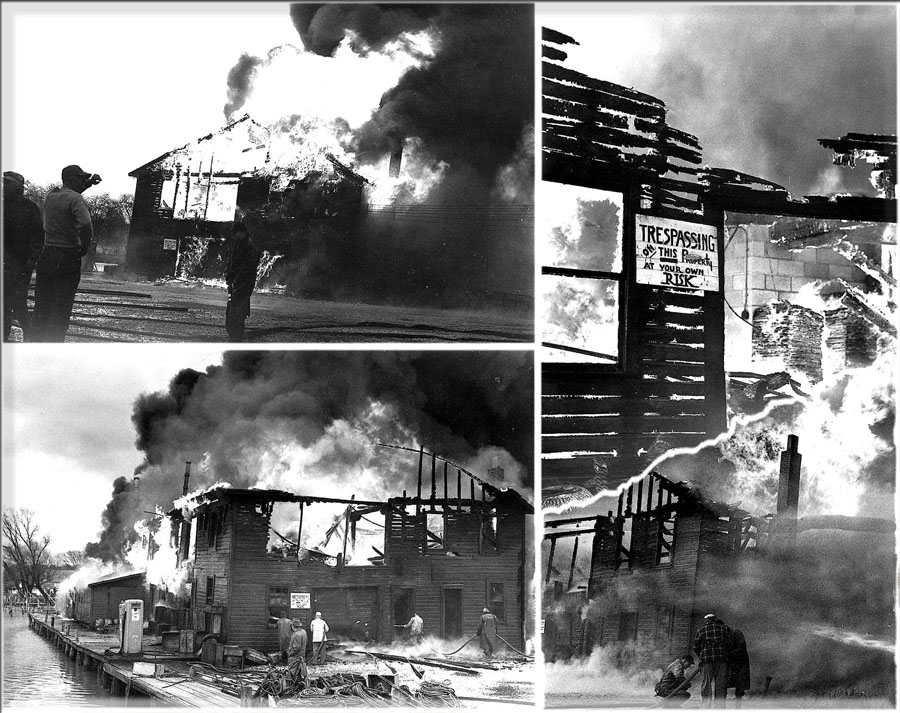
"...shortly after noon on November 16th when a bucket of tar that was being used to coat fishing nets caught fire and overturne."
IT WASN’T JUST ANOTHER FIRE: Vermilion has certainly seen its share of calamitous fires. In 1875, 1891, and 1903 many of the stores and shops located along the southwest side of Liberty and Division / Main Streets were destroyed by flames. In April of 1910 twenty-two cottages in Linwood Park went up in smoke. So very common did these blazes seem - at least to village outsiders - that after the 1903 conflagration a small headline in the old Erie County Recorder somewhat sardonically reported that “Vermilion Burns Again”.
Of course those were neither the only nor the last big fires to take place in or around the community of Vermilion, O. During the first half of the 20th century there were major fires at the Wakefield Brass Company, Southwest Fish (1925), the Fischer Lumber Company (1938), and the Crystal Beach Amusement Park (1947). Yet, of all these blazes the one that may be - at least historically - among the most significant is that which struck the Leidheiser and Booth Fisheries in 1951. In fact the Elyria (Ohio) Chronicle Telegram would later call it ”One of the worst fires in the history of this quiet Summer resort and fishing village”.
By 1951 the Leidheiser Family had been involved in the fishing industry in Vermilion for over a century. Brothers, George, Vern, and Jack along with their cousin Lloyd Leidheiser, operated the business in two buildings located along the banks of the Vermilion River. They were sandwiched between the former Fischer Lumber Company (to the west), and the Moes Boat Yard (to the east). The Leidheiser-Booth relationship was symbiotic. Leidheisers caught the fish, and Booth marketed their catch.
It was shortly after noon on November 16th when a bucket of tar that was being used to coat fishing nets caught fire and overturned. Quickly it spread to the walls and roof of both buildings. With a strong west-wind fanning the flames the Vermilion Volunteer Fire Department, under the direction of then Fire Chief Roy Hurlbut, struggled to extinguish the blaze. (See photographs) The situation was so serious Hurlbut requested and received assistance of volunteer fire-fighters from what was then the Village of Vermilion-On-The-Lake and one company from the nearby City of Lorain. Unfortunately, all they could do was contain the fire to the general area.
When it was all over both buildings were completely destroyed and the Moes Boat Yard next door had sustained at least a $50,000 loss. A dozen boats stored in the yard had been damaged - two of them beyond repair. The Leidheiser loss was estimated to be about $150,000. One of the buildings contained much of the most valuable fishing nets and equipment in the village. Men from other village fisheries had been warehousing their better nets there and were using their older equipment for the Fall fishing season.
As previously said this particular blaze was among the most significant in the history of Vermilion. No small part of the reason that this is true is because the fishery was never rebuilt, and, therefore, the Leidheiser Fish Company - after being a positive and productive participant in commercial fishing for over a hundred years - ceased to exist.
Although the industry continued to operate from various fisheries in Vermilion and along the southern coast of Lake Erie for perhaps two or three decades following this blaze it is clear that the destruction of the Leidheiser fishery wasn’t just another fire. It was the beginning of the final chapter in the life of commercial fishing in Vermilion’s yesteryear.
Ref: Elyria Chronicle Telegram, 1-17-1951; Special thanks to Dwight McMullen; Published 1/22/09; Written 1/18/09 @11:50 AM.


THE AUTOCRAT
Ok Folks. I’m going to make it official. I, hereby, declare the Vermilion River to be scenic. So the State of Ohio can just forget about declaring it “scenic” and move on to other things...like implementing an appropriate and fair funding program for primary and secondary education.
All in favor say “Aye”.
“Aye.”
All opposed?
========================================
Now then - about the emergency weather sirens in Vermilion: What Mensa midget dreamed up a warning system that alerts the public about emergency weather conditions that don’t exist?
Is this supposed to be a joke - or what?
Did no one ever tell them the old story about the boy who cried “Wolf”?


PODCASE #180:This week the Vermilion Views Podcast #180 is just (a little more) fun. Tis a clip of Tom Rush bemoaning the loss of his wallet. Perhaps you can identify...
Persons interested in the history of the Lake Shore Electric Railway (which was the subject of a recent past podcast series) - "the greatest electaric railway system on the planet" may want to go to Amazon.com and purchase a book called "Images of Rail - Lake Shore Electric Railway". It was put together by Thomas J. Patton with the help of my friends Dennis Lamont and Albert Doane. It'd make a nice gift.
Also, please note that all the video (MP4) podcasts (when used) are done in the "Quicktime MP4" format. If you don't have "Quicktime" it's easy to find and free to download.
NOTE NOTE:Past podcasts are not available in the on-line archive. They just take up too much disk space. But if one really, really, really wants to acquire a copy of a past cast it can be had by contacting me and I will place it on a disc and send it to ye for a minimal fee.

LOCAL ANNOUNCEMENTS: After giving it much thought this link has been "put-down". During the last year most of the folks who used to use this page as a bulletin board have acquired their own and, consequently, no longer need this forum from "Views". I have, however, kept links (in the links section) to Larry Hohler's "Hope Homes" in Kenya - and to Bette Lou Higgins' Eden Valley Enterprises sites. They are historically and socially relevant projects. I suggest that you visit these sites on a regular basis to see "what's shakin'".

Pay particular note to the "Hope Homes" page during the next few months. They are constantly improving the lives of their youngsters and those around them. This is an exciting project accomplished by exciting people.
Although this years Vermilion High School Class of 1959 reunion is over classmates may want to stay connected with each other through organizer Roger Boughton. Ye can connect by mailing him @ 2205 SW 10th Ave. Austin, MN. 55912 or you can just emailRoger.
Where's Alice? I found this link interesting. You just never know what Vermilion expatriots are up to - or where their up to doing it. Alice Wakefield is one of those people. So check out his link. Methinks you'll be surprised: Talking Turkey.








The Beat Goes On: The page is generated by the dreaded Macintosh Computer and is written and designed by (me) Rich Tarrant. It will change weekly ~ usually on Saturday. Bookmark the URL (Universal Resource Locater) and come back at your own leisure. Send the page to your friends (and enemies if you wish). If you have something to share with those who visit this page, pass it on. And if you see something that
is in need of correction do the same. My sister, Nancy, is a great help in that respect. It only takes me a week to get things right. And follow the links. You might find something you like. If you experience a problem with them let me know. Also, if you want to see past editions of this eZine check the new archives links below.
If you're looking for my old links section (pictured) I've replaced it with a pull-down menu (visible in the small box next to the word "Go"). If you're looking for links to more Vermilion history check that menu.

How the old links menu looked

For Persons who would like to donate to the cause (to keep these "Views" on-line you can send whatever you would like to me at the following address. And THANKS to everybody who has already donated to the cause. I doth certainly appreciate it):
Rich Tarrant
1041 Oakwood Drive
Vermilion, Ohio
44089
Telephone: 440-967-0988 - Cell: 440-522-4459
or you can use PayPal: (NOTE: IT WORKS NOW)
"Sunshine is delicious, rain is refreshing, wind braces us up,
snow is exhilarating; there is really no such thing as bad weather,
only different kinds of good weather."
-John Ruskin
Vol.8, Issue 9, May 15, 2010
Archive Issue #374
Vermilion Views Search Engine


© 2010 Rich Tarrant